EARTHCEM
A CEMent harnessing EARTH for a sustainable built environment
Research Framework
Developing Durable and Sustainable LC3 Systems
EARTHCEM investigates how locally available UK clay resources can be utilised to develop high-performance Limestone Calcined Clay Cement (LC3) systems for sustainable construction.
The project seeks to establish scientific links between clay mineralogy, reactivity, hydration, microstructure, durability, and long-term performance. Through a combination of experimental investigation and sustainability assessment, EARTHCEM aims to support the wider adoption of low-carbon cement technologies.
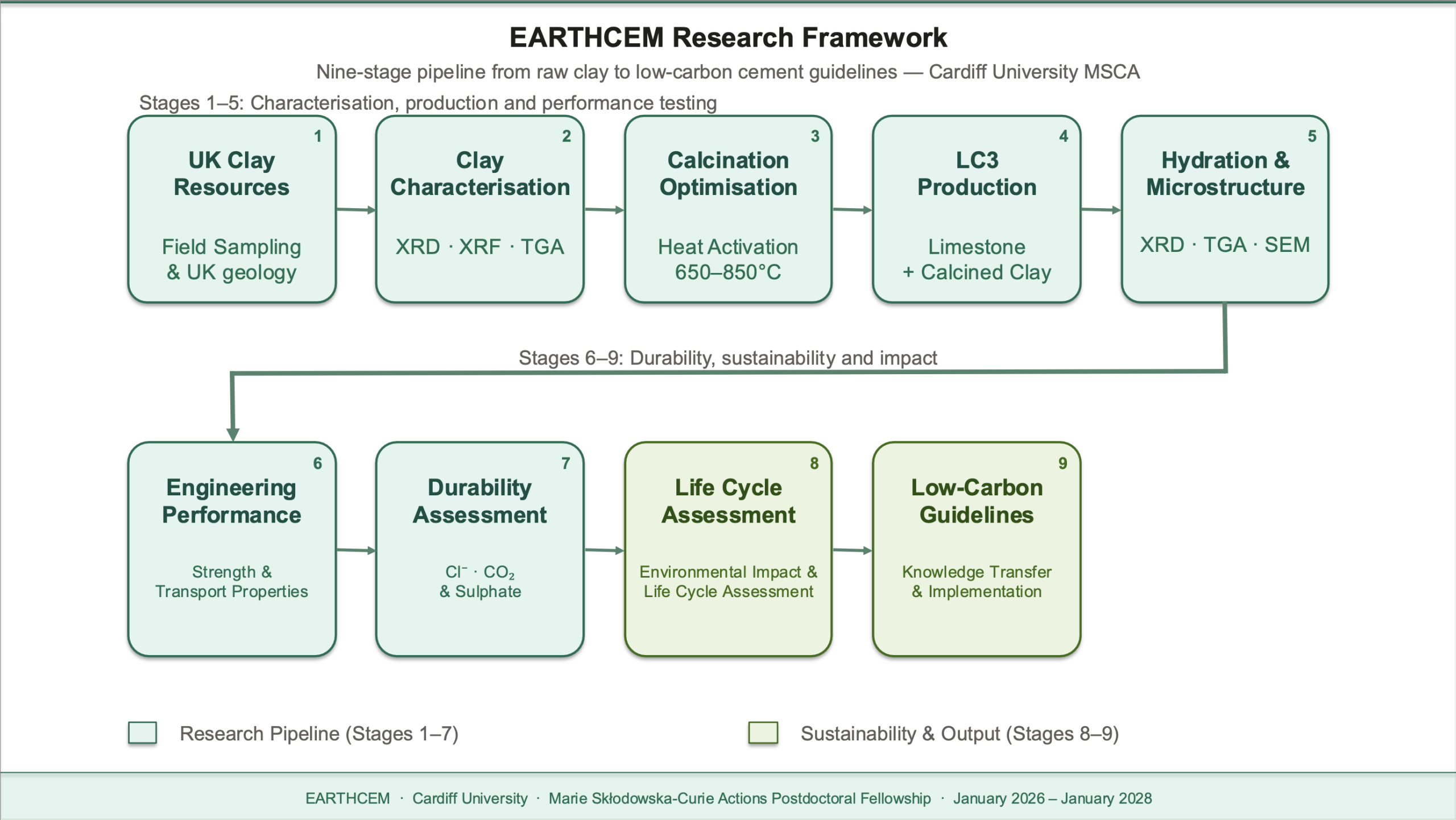
Figure 1. EARTHCEM Research Framework illustrating the nine-stage pathway from UK clay resources to low-carbon cement guidelines.
Research Vision
The central research hypothesis of EARTHCEM is that the mineralogical characteristics of clay resources strongly influence the performance and durability of LC3 systems.
The project investigates the complete pathway from raw materials to long-term infrastructure performance:
The EARTHCEM Research Framework investigates the complete pathway from UK clay resources to durable and sustainable LC3 systems, linking raw material characteristics with long-term infrastructure performance.
Understanding these relationships will help develop scientific guidelines for designing durable and low-carbon cement systems using locally available resources.
Research Objectives
EARTHCEM has six key objectives:
- Characterise representative UK clay resources suitable for LC3 production.
- Investigate the influence of clay mineralogy on thermal activation and reactivity.
- Understand hydration mechanisms and microstructural development in LC3 systems.
- Evaluate fresh and hardened performance of LC3-based materials.
- Assess durability under aggressive environmental exposure conditions.
- Develop service-life and sustainability assessment frameworks for LC3 applications.
WP1 – Clay Resources and Reactivity
This work package focuses on identifying and characterising UK clay resources suitable for LC3 production.
Activities include:
- Mineralogical characterisation of clay deposits.
- Thermal activation and calcination studies.
- Assessment of reactive alumina availability.
- Evaluation of dissolution and reactivity behaviour.
The outcomes will provide a scientific understanding of how clay composition influences LC3 performance.
WP2 – Performance and Microstructure
This work package investigates the engineering performance of LC3 systems.
Activities include:
- Mix design optimisation.
- Hydration studies.
- Mechanical performance assessment.
- Microstructural characterisation.
- Transport property evaluation.
The aim is to understand how clay characteristics influence the development of durable cementitious materials.
WP3 – Durability and Sustainability
This work package evaluates the long-term performance and environmental benefits of LC3 systems.
Activities include:
- Chloride ingress assessment.
- Carbonation resistance evaluation.
- Service-life prediction.
- Life Cycle Assessment (LCA).
- Sustainability assessment.
The outcomes will support the development of low-carbon cement systems capable of delivering long service lives in demanding environments.
Research Methods
EARTHCEM employs a range of advanced material characterisation and testing techniques, including:
Advanced Material Characterisation
EARTHCEM uses a range of advanced analytical techniques to investigate the composition, reactivity, and microstructure of clay resources and LC3 systems. These methods help understand how material properties influence cement performance and long-term durability.
Performance and Durability Testing
Laboratory testing is used to evaluate strength development, transport properties, and resistance to environmental exposure conditions relevant to infrastructure applications.
Sustainability Assessment
Environmental performance is assessed through service-life modelling and life-cycle assessment approaches to evaluate the potential benefits of LC3 technologies.
Expected Research Outcomes
EARTHCEM will generate new scientific knowledge on the utilisation of UK clay resources in LC3 systems and provide evidence to support the development of durable, low-carbon cement technologies.
The project aims to contribute to reducing the environmental impact of cement production while supporting the transition towards a more sustainable built environment.
The knowledge generated through EARTHCEM will support the wider implementation of LC3 technologies and contribute to the transition towards a low-carbon and resource-efficient construction sector.